Trade Secrets in Business: Why They Matter and What’s at Stake
%20(1).png)
Trade secrets are at the heart of modern business. From business insights to technical innovations, they represent unique value and tremendous investments of time, labor, and capital. It’s no surprise companies go to huge lengths to protect them.
That's why we've launched this in-depth series. Our mission is to help educate and equip businesses with practical insights they can use to safeguard their information assets. At the center of this effort is a book from trade secret attorney Maxwell Goss: Your Trade Secrets Are Easy to Steal! Secure and Supercharge the Hidden Assets That Power Your Business.
Whether you're a founder protecting your company's unique offerings, a partner managing client relationships, a research lead overseeing product development, or an advisor guiding sensitive business transactions, leaders in your position need clear, actionable guidance. Regardless of your company’s industry or stage of growth, in these articles you’ll find essential information and steps you can implement right away without slowing your business down.
This piece, which is the first in our multi-part series, offers key insights on why trade secrets have become the cornerstone of business value and what's at stake when they're compromised.
Trade Secrets are Everywhere
Consider the taste of the drink you’re sipping, the engineering in your smartphone, or the algorithm telling you what shows to binge-watch. These products of human ingenuity all rely on valuable trade secrets, and the battle to keep them under lock and key can be fierce indeed.
But trade secrets go far beyond consumer brands and flashy tech. They’re foundational for all kinds of companies, whether they build bridges, brew beer, make widgets, or deliver services.
Trade secrets are embedded in your customer lists, your market research, and your pricing strategies.
They’re woven into your custom software, your innovative formulas, and your unique processes.
They’re reflected in the notes logged in Salesforce by your sales reps, the CAD models developed by your engineers, and the quality controls your production team has perfected.
If information adds value to your business and it isn’t known to the outside world, it could be a trade secret—and it deserves protection.
Trade Secrets are Pivotal
When I was in law school, trade secrets were half-jokingly dismissed as the “unwanted stepchild” of intellectual property—an afterthought compared to patents, copyrights, and trademarks.
Things couldn’t be more different now. Trade secrets have become core assets for many businesses, often representing the most valuable and least replaceable part of a company’s asset portfolio.
Fifty years ago, physical assets such as factories, equipment, and inventory made up 83% of the market value of S&P 500 companies. Today, that picture has completely flipped. One study found that an astonishing 92% of top U.S. companies’ market value now comes from intangible assets, including trade secrets. Another study found that intangible assets worldwide had reached $80 trillion in value in 2024, a 13-fold increase since 1996.
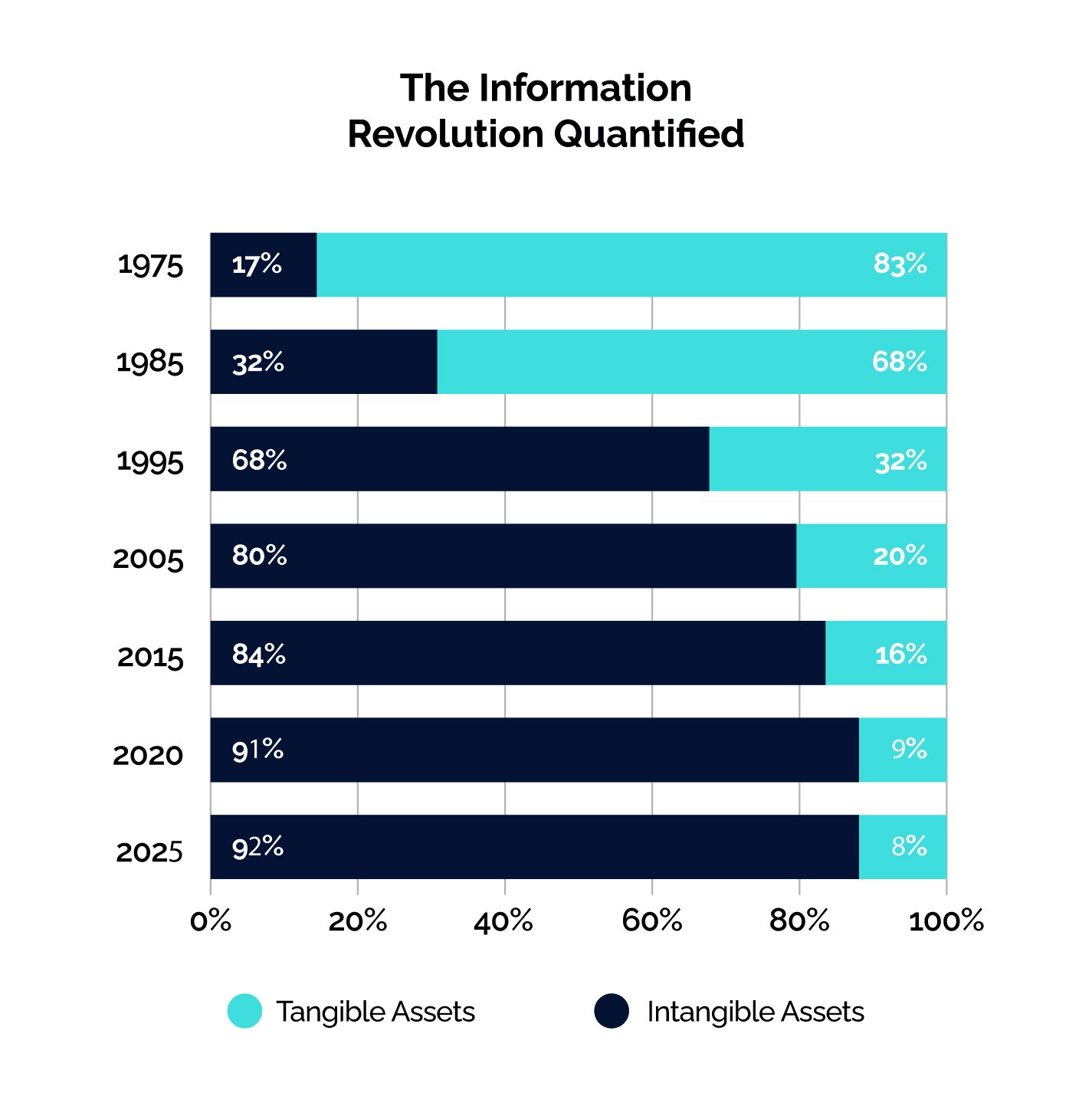
This shift tracks the rapid rise of the information economy, where knowledge and innovation have taken center stage. And the transformation isn’t limited to Silicon Valley. Even traditional industries such as healthcare, manufacturing, transportation, hospitality, and banking now depend on proprietary knowledge to stay competitive.
The Clock is Ticking
Movies and television capture the incredible power and value of trade secrets, but they often miss a crucial point: in the real world, trade secrets can be stolen in a heartbeat. Unlike physical assets, trade secrets are highly portable, copyable, and shareable. Misappropriation usually happens quietly through forwarded emails, surreptitious downloads, and private conversations.
And when it happens, trade secret theft exacts a massive toll.
Just look at the lawsuit between Uber and Waymo, the self-driving car division of Google. A Google employee left with 14,000 files, started his own company, and soon sold that company to Uber. The litigation that followed cost Uber $245 million and came close to killing its autonomous vehicle program.
No company is immune to trade secret misappropriation. When it strikes, it can cripple any organization, with effects ranging from lost sales and eroded market share to fractured customer relationships and disrupted operations.
In some instances, trade secret theft threatens the business’s very survival.
Doing nothing is not an option. Given the dangers all around, properly safeguarding your trade secrets must not be an afterthought. It’s an imperative for modern business.
Take the Next Steps and Continue Reading
With that context set, it's time to confront the threats head-on. Check out “What Happens When Your Trade Secrets Walk Out the Door” to see the real-world scenarios that could devastate your business, and why the danger may be closer than you think.
Join Trade Secret University
Subscribe and receive our curated monthly email digest plus instant access to the Trade Secret Vault. The Vault has exclusive content like practical guides and actionable toolkits.
Maxwell Goss is a litigation and trial attorney at Goss Law Group. Max represents clients in trade secret, intellectual property, and business litigation cases in Michigan and nationwide.

.jpg)
.png)
%20(2).png)
%20(1).png)
%20(1).png)
%20(2).png)
.png)