Four Advantages of Trade Secrets

Many processes, systems, and intelligence are difficult or impossible to protect with patents and copyrights. While trade secrets complement these other types of IP, as well as other intangible and tangible assets, knowing when to choose which type of IP protection isn’t always obvious.
Additionally, there's no government agency to guide the process and no certificate to prove you’ve succeeded. The responsibility for identifying and protecting these assets rests with you.
When your company depends on changing algorithms, evolving customer insights, or operational know-how that accumulates over a period of years, trade secret protection can be a strong choice because it adapts along with your business.
In upcoming articles we’ll talk further about the specific ways in which trade secrets can bolster business value if incorporated into your operations, product development, marketing strategies, and more.
While those broader benefits deserve their own discussion, the four trade secret advantages below are focused on how trade secrets stack up against other forms of IP when it comes to protecting your business information. That’s also why the graphic depicts these advantages as a shield—highlighting their defensive power when understood and leveraged together.
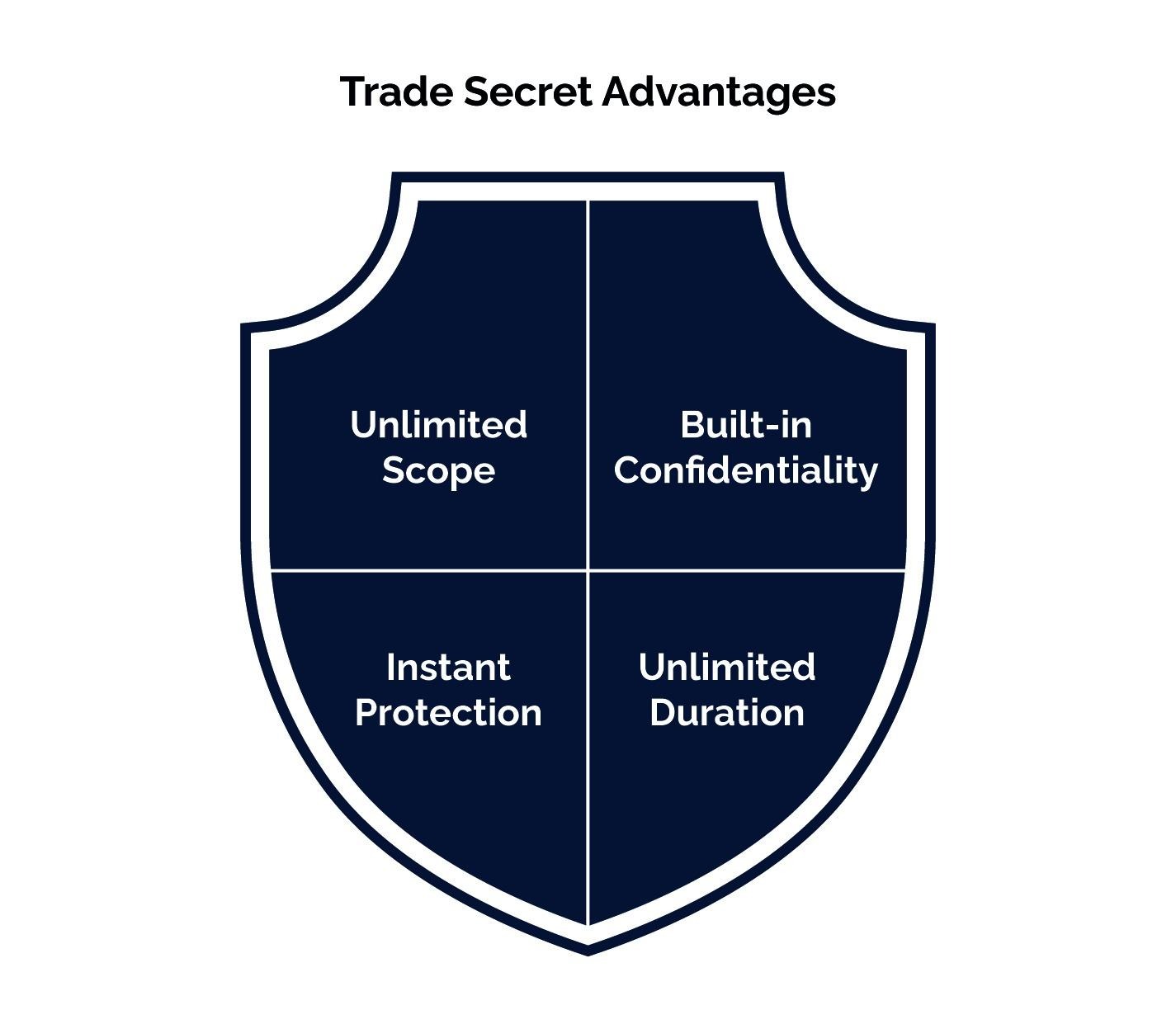
Four advantages of trade secrets:
- Unlimited Scope. Trade secrecy covers every type of business knowledge without the more rigid boundaries of other forms of IP and allows you to protect it in ways that fit your unique business needs. Depending on the type of information, this can be a significant advantage. For example, while patents are generally technical in nature, trade secret protection can be applied to any and all types of proprietary information. To be sure, some trade secrets are technical, but many are not. And trade secrets are not subject to the stringent novelty requirements for patents.
- Built-In Confidentiality. Trade secrecy by definition keeps valuable information confidential and out of competitors’ hands, unlike other forms of IP, which generally require public disclosure.
- Instant Protection. You don’t need to jump through administrative hoops, wait years for government approval, or risk rejection. Trade secret protection can happen entirely in-house, and it starts the moment you implement reasonable safeguards.
- Unlimited Duration. While patents and copyrights expire after a fixed number of years, trade secrets continue to protect insights and innovations for as long as they remain secret and retain their business value. If the value that trade secrets provide your business won’t expire, then neither should their protected status. After a patent reaches the expiry date, your competitors can use them to introduce new products and services.
By offering long-term protection, immediacy, breadth, and confidentiality, these advantages make trade secrecy uniquely suited to the information that defines success in the modern economy.
How trade secrets compare to other forms of IP
The benefits above show what trade secrets do well. But making an informed decision on the right protection for a given asset relies on understanding the differences between trade secrets and every other tool in the IP toolkit.
Forthcoming articles in this series will compare trade secrets against patents, copyrights, trademarks, and contractual protections like NDAs and non-competes. Each comparison will focus on key differences, advantages and disadvantages of each form, and the types of information or risks that make one approach a superior fit.
Maxwell Goss is a litigation and trial attorney at Goss Law Group. Max represents clients in trade secret, intellectual property, and business litigation cases in Michigan and nationwide.
.jpg)
.png)
%20(2).png)
%20(1).png)
%20(1).png)
%20(2).png)
.png)
%20(1).png)